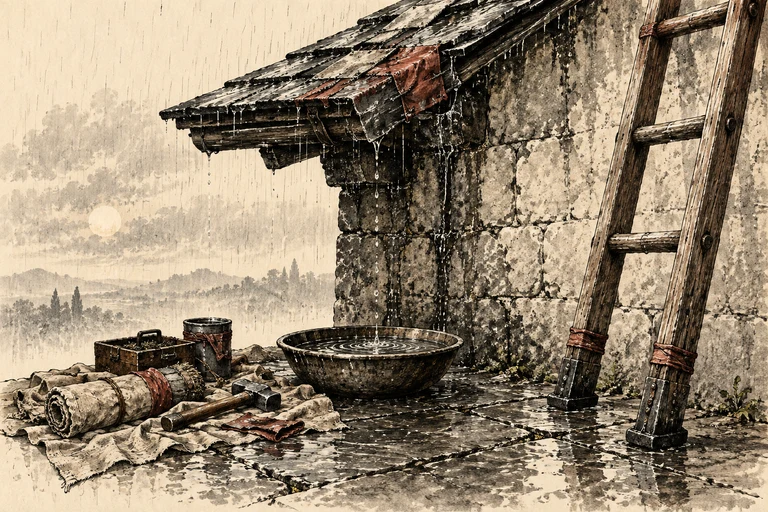
Conditions, not a clock
The five states describe what people are living through, not five scheduled steps. Districts do not change together. Flood-hour names a threshold being crossed, not a numbered hour. A household can still be repairing after-spike damage while the next street has resumed trade.
Each state changes crowding, visibility, sound, prices, and the reliability of a route. A passage can hide a traveler under one condition and expose them under another. Longer cycles such as long wet or heat hold operate at a different scale.
Baseline and spike
In baseline rain, routes function, toll mouths stay occupied, vendors trade, and chalk directions are mostly trustworthy. Ordinary danger has become familiar enough to move through quickly. The useful travel window still costs someone time: a caregiver or stall keeper may remain behind while others use it.
Spike rain compresses distance to the next wall or handhold. Checkpoints and crowds move beneath overhangs. Dry wrapping and shelter become more expensive. Vendors fold their stalls, protect stock, and decide whether to finish a delivery or abandon the load. People unable to move quickly often arrive after the shelter's space and price have changed.
Hush and flood-hour
Hush rain continues while the expected sound falls wrong. Speech carries too far; names and arguments become attention. Gestures, taps, and short phrases replace explanation. Anyone unable to see local signals or suppress a cry is made conspicuous by a silence that helps somebody else.
At flood-hour, low routes hard-close, basins expand, and the underlayer chokes. Escorts may become mandatory or impossibly expensive. Stock rises, ropes cross lanes, dependents move inward, and people account for those left on both sides. Rescue, transport, and extortion can share the same outstretched hand.
After-spike
Searching, washing, repair, drying, care, and route testing begin before mourning finishes. Enforcement may return to newly exposed spaces. New chalk, missing signs, altered prices, debt, and restrictions change the next day's map.
An open route does not restore a missed meal, spoiled medicine, or labor spent protecting another household. Successful rescue matters, and so does the work it creates. Recovery is another condition to live through, not the point at which the city resets.